

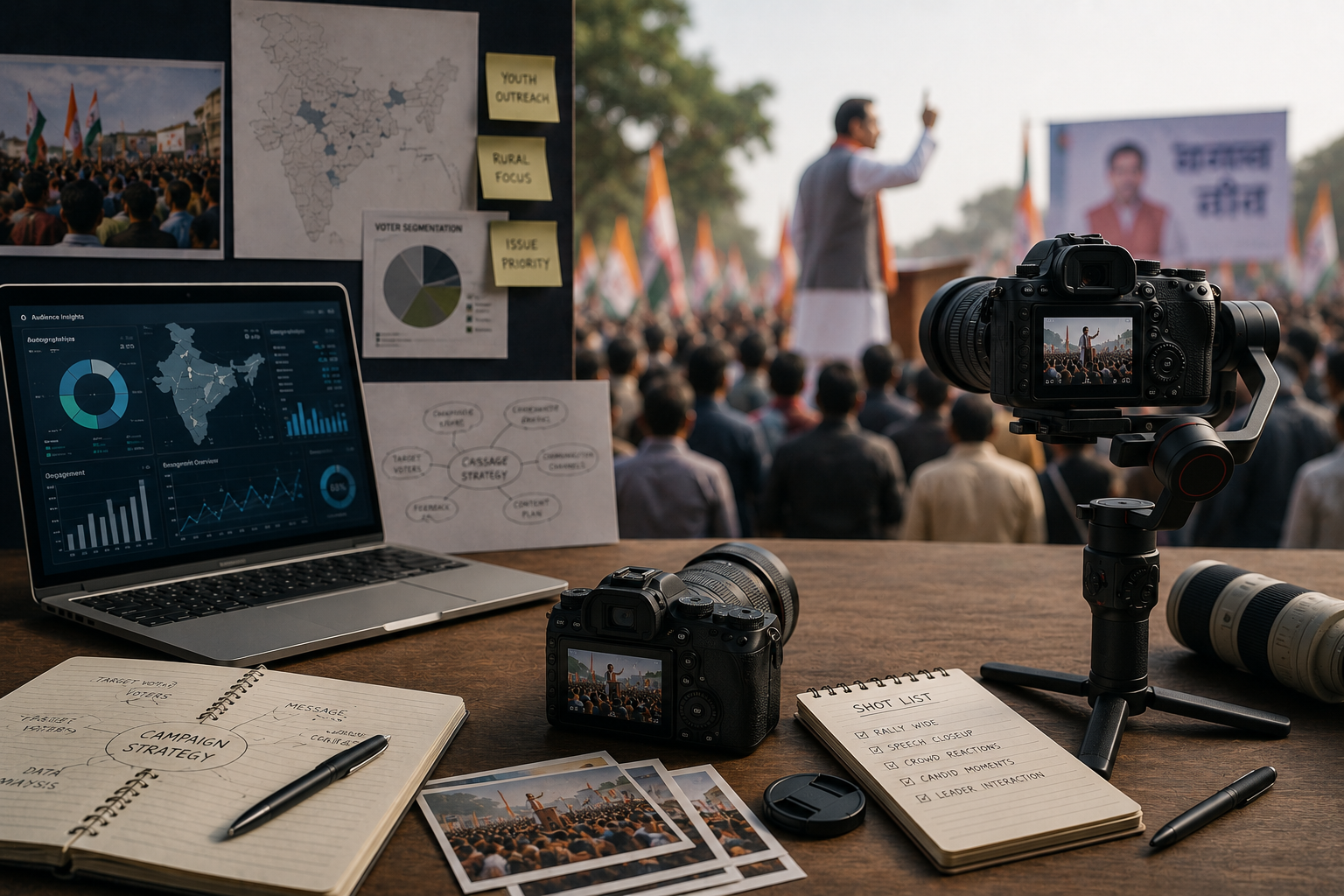
Every political consultant will tell you they offer “full-service” campaign support. Almost none of them mean it the way a first-time candidate assumes. Two genuinely different jobs get bundled into the same pitch — political digital marketing and political content production — and mixing them up is one of the more expensive mistakes a campaign can make, usually discovered only after the budget’s already spent.
What political digital marketing actually does
This is the strategy and distribution side of a campaign. It answers one question: who do we reach, and with what message? In practice, that means voter data analysis and micro-targeting, ad spend management across Meta and Google, WhatsApp and SMS broadcast campaigns, sentiment tracking and social listening, and the war-room dashboards that show a campaign team how a message is landing in real time. The people doing this work are data analysts, media buyers, and strategists. It’s genuinely skilled, necessary work — and it’s also what most political agencies in India are actually built around.
What political content production actually does
This is the creative and craft side — the part that answers a different question: what do we actually show people? It covers candidate documentaries and profile shoots, daily coverage of rallies and events with same-day editing, press-ready photography, short-form reels built for how people scroll, and the day-to-day social account management that keeps all of it flowing consistently. The people doing this work are videographers, photographers, editors, and producers — a production team, not a strategy team.
“The best political campaigns don’t just reach people. They give people something worth watching, remembering, and sharing.”
Exprosight
-Author
Where they compare, side by side
| Political Digital Marketing | Political Content Production | |
|---|---|---|
| Core question | Who do we reach, and with what message? | What do we actually show them? |
| Typical deliverables | Voter data, ad targeting, WhatsApp/SMS campaigns, sentiment tracking, dashboards | Documentaries, daily shoot-and-edit coverage, press photography, reels, social management |
| Team | Data analysts, media buyers, strategists | Videographers, photographers, editors, producers |
| How you’d know it’s working | Reach, click-through rate, spend efficiency, sentiment shift | Whether the footage looks real, holds attention, and gets shared |
| What it can’t do alone | Target the right voter with nothing worth showing them | Make strong content go anywhere without a plan behind it |
Why the line gets blurry
Most agencies that pitch “full-service political campaigns” are strategy shops first, with a junior videographer or a freelance photographer added to the package so they can say yes to everything. That arrangement works fine for the dashboards and the ad spend, because that’s the team’s actual core skill. It shows up fast in the footage, though — content becomes the thing squeezed in around the ad calendar rather than planned on its own timeline, and by the time anyone notices, there’s a campaign’s worth of shaky, inconsistent visuals already published under the candidate’s name.
The reverse happens too, just less often: a strong production house gets asked to “also handle the digital strategy,” and ends up running ad spend and voter targeting with nowhere near the depth a dedicated strategist would bring.
Which one do you actually need?
Almost every real campaign needs both — the question is whether you’re getting both from people who are actually good at each one. A few honest questions surface this fast: Who specifically is shooting and editing the content, a named person with a reel to show you, or “the team will handle it”? Is content planned on its own calendar, or does it only happen around ad spend meetings? If you asked to see the last three campaigns this agency ran, could they show you finished footage, or just performance dashboards?
None of those questions are about picking a side. A campaign built entirely on targeting with nothing compelling to show a voter fails quietly. A campaign built entirely on beautiful content with no plan for who sees it fails just as fast, more expensively. The two functions need each other — they just don’t need to live inside the same, overstretched team.
Quick answers
Can one agency genuinely do both well? Some can, but it’s rare enough to verify rather than assume — ask to see dedicated people and finished work for each side, not just one combined pitch deck.
Do I have to hire two separate vendors? Not necessarily. What matters is knowing which one you’re actually paying for at any given moment, so neither side quietly gets underfunded.
Which one should get the bigger budget? Neither, categorically — it depends on where your specific campaign is weakest. Most first-time candidates underspend on content because it’s easier to point at a dashboard and call it progress.
Where Exprosight fits
We’re on the content production side of this — documentaries, daily campaign coverage, press-ready photography, and the social media management to keep it all consistent — and we’re built to work alongside whatever strategy or digital marketing partner a campaign already has, not compete with it. If you already have a strategist and just need the content half done properly, that’s exactly the conversation worth having before the campaign gets busy.