

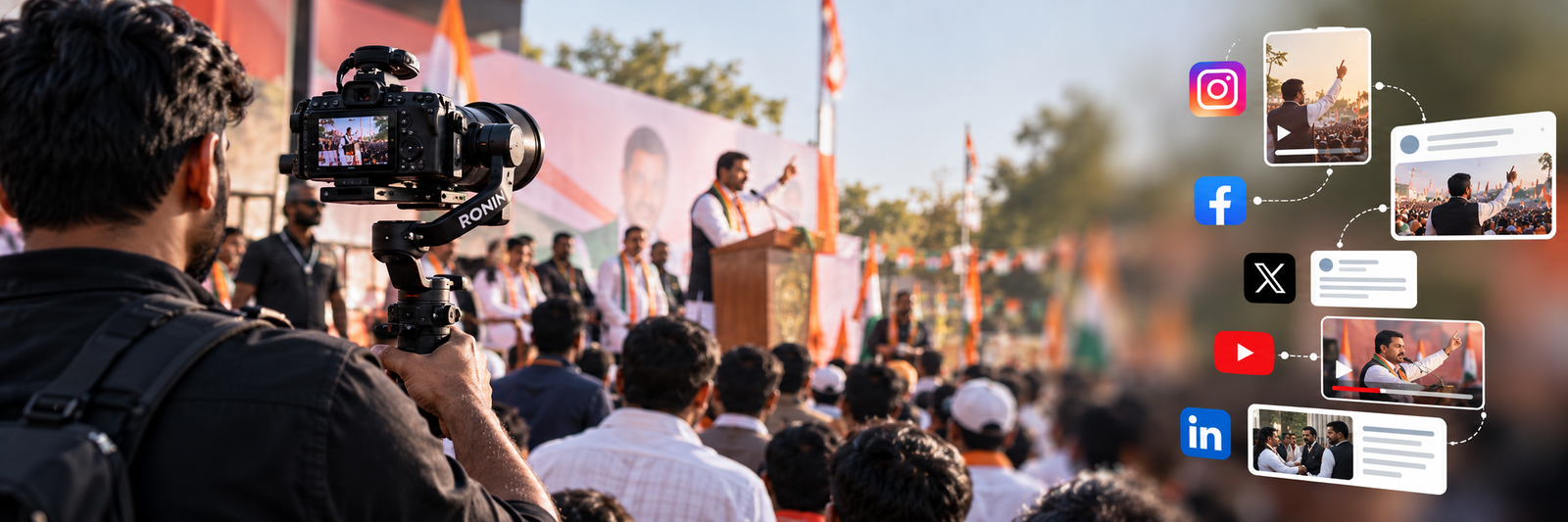
Most campaigns run their content marketing backwards. A video gets shot, and the question becomes “where do we put this” — so it goes up on Instagram, Facebook, and YouTube, and gets forwarded on WhatsApp, all as the identical clip. It performs fine everywhere and brilliantly nowhere, because none of those platforms were actually the reason it got made.
Social media content marketing for a political campaign isn’t “make videos and distribute them everywhere.” It’s deciding, before the camera comes out, which platform a piece of content is actually for — because a voter opens Instagram, WhatsApp, and X for three completely different reasons, and content built for one rarely does its job on another.
“A campaign doesn’t need more content. It needs the right content in the place a voter is actually looking for it.”
Exprosight
-Author
What each platform is actually doing in a campaign
Instagram and YouTube Shorts are where a candidate reaches people who aren’t already following the campaign — the algorithm surfaces reels to strangers, which makes this the discovery layer. It’s also the platform where the shoot-day mechanics matter most: how a reel gets framed, captioned, and cut on the day is its own discipline, worth its own conversation.
Facebook still carries weight with an older and more geographically spread audience than Instagram does, and its groups and event pages do something reels can’t: let a local constituency organise around a candidate, not just watch one.
WhatsApp is arguably the least “contenty” platform on this list and the most consequential one in an Indian election. Broadcast lists and forwarded messages are how a huge share of voters actually hear from a campaign directly, and yet it’s usually the platform treated as an afterthought — whatever got made for Instagram, resized and forwarded, instead of anything built for how people actually read a message there.
X is where journalists, the opposition, and the political class are watching in real time, especially once an election is actually called. Content here isn’t really aimed at voters first — it’s the platform where a rapid-response clip either gets ahead of a story or lets someone else write it first.
The content mix, not just the platform mix
Underneath all four platforms, a campaign needs a handful of genuinely different content types doing different jobs, not one video reused four ways — which is usually where a coordinating agency earns its keep over a handful of freelancers each covering a single piece.
Testimonials and vox pop — a real voter, on camera, saying why they’re voting for a candidate does more for trust than the candidate saying it about themselves.
Documentary-style coverage — the longer, slower footage a videographer builds to give someone curious enough to spend three minutes a real sense of the candidate, not just a highlight.
Press-style photography — the formal shots a photographer builds for print and online news pickup, which still shapes how a campaign gets covered outside its own channels.
Rapid-response content — same-day, sometimes same-hour, built to answer whatever just happened in the news cycle rather than what was planned a week ago.
Policy explainers — short, plain-language pieces that do the unglamorous work of actually telling a voter what a candidate would do, which reels and photography alone rarely cover.
A campaign leaning entirely on one of these — usually reels, because they’re the most visible — ends up with reach and very little underneath it.
Where this tends to go wrong
The same clip goes up everywhere, unedited for the platform it’s landing on. WhatsApp gets treated as a distribution afterthought instead of its own channel. Rapid-response content gets planned like everything else, a week out, by which point the moment it needed to answer has already passed. And content stops the day the campaign does, instead of building the following a candidate needs before the next election is even announced.
Quick answers
Do we need a different video for every platform? Not always a different shoot, but usually a different edit — length, captions, and framing change even when the underlying footage doesn’t.
Which platform matters most? Depends on the seat and the voter base far more than any general rule. A campaign in a young, urban constituency leans differently than one in a rural, older one — that’s usually the first real strategy conversation worth having.
Should a candidate be posting content outside election season? Content built only during campaign season is starting from zero every time. A steady, low-key presence between elections is what makes campaign-season content land on an audience that already recognises the candidate.
Where Exprosight fits
As a political content agency, this is the strategy layer we sit alongside the shoot itself — working out what a campaign actually needs on Instagram, Facebook, WhatsApp, and X before a photographer or videographer is ever booked for the day. We build the testimonials, the documentary footage, the press photography, and the rapid-response pipeline as one coordinated plan, for campaigns across Uttar Pradesh, Delhi NCR, and beyond. If your content has been going up everywhere the same way, that’s usually the first thing worth fixing.